Sat Feb 24 14:20:06 CST 2007
NetBSD pkg_add problem
Small problem today. I installed NetBSD 3.1 on mooloolaba, my Sun Sparcstation 20, yesterday. I was trying to use pkg_add to add some binary packages that I like, such as irssi, bash, and screen. Alas, no luck. The ftp logins kept failing, even though I had properly assigned the variable PKG_PATH to the correct one.
It turns out that the problem was that this version of NetBSD is not doing anonymous logins properly, and that was causing the FTP logins to fail. Even manual logins would fail, requiring you to use the user and pass commands to log in. The solution: Create a ~/.netrc file containing:
default login anonymous password youremailaddress@spamsucks.org
Here are some pictures:
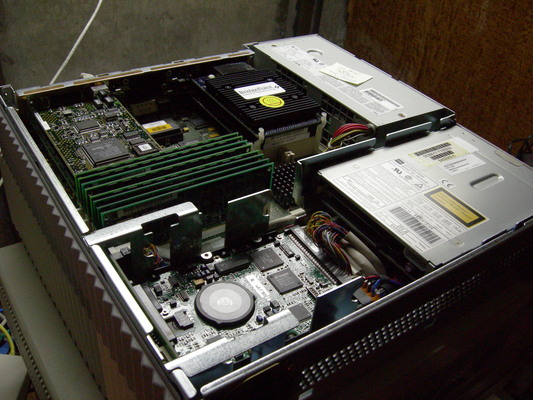
That is before the mods...
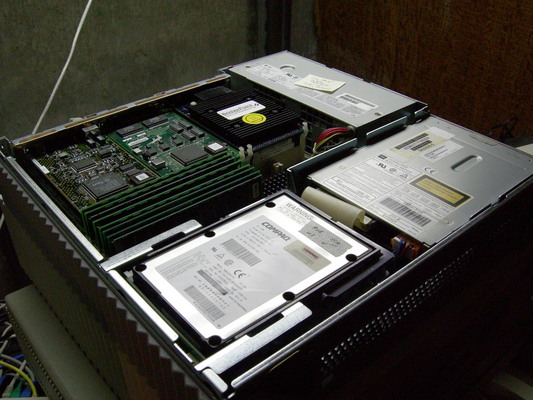
...and after. I took out the 4.3 GB SCSI-2 drive and installed a pair of 8.6 GB SCA SCSI-3 drives, which freed up the SCSI-2 connector so that I could finally connect the CD-ROM drive. (Sparcstations use proprietary CD-ROM drives - they are normal SCSI but the form factor is unique. They are quite short height-wise.) I also put in an Ultra-SCSI controller in a free SBUS slot (you can see it in the middle at the back). The SBUS card beside it is the HME "Happy Meal" Fast Ethernet controller; the built-in Ethernet is only 10BaseT and the HME is 100BaseTX. You can also see the topmost of the two Ross 180 MHz HyperSparc processors that I installed a few days ago. Underneath the HME NIC is the Low Cost Graphics cgsix framebuffer, which I am not currently using since mooloolaba runs headless.
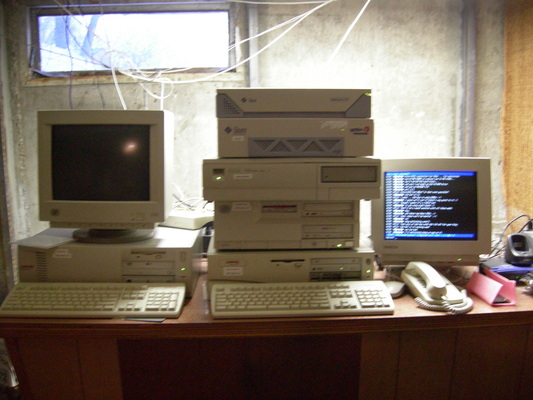
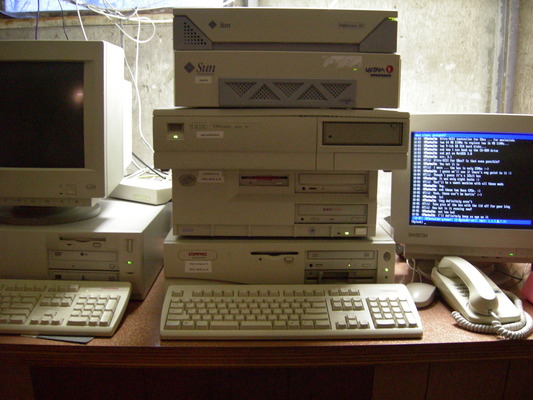
For general interest, here are some pictures of my "tower of computers": hobart (PII web/email/file server; home of this blog) at left; on the pile, top to bottom: mooloolaba (Sparcstation 20), moora (UltraSparc 1/170E, home of one of the Metanetwork IRC servers; maroochydore, my VAXstation 4000/60, running OpenBSD 4.0; canberra, an ancient 486sx25 with 32 MB of RAM that is soon to be retired; and devonport, my firewall, a Pentium 133. The latter two machines and moora run Debian Linux.
Sun Feb 4 12:05:47 CST 2007
Astronomically geeky
Celestia is the coolest program ever.
Basically, it's a universe simulator of sorts. You start in the solar system. You can surf around, looking at objects in the solar system from all angles. Lock on this object, follow that, and you can have some really neat views.
For example, hit enter and type "Iapetus". Hit C to centre. Hit G to go. There's Iapetus. No big deal. Use your mouse scroll wheel to make Iapetus smaller. Click on Iapetus and drag it to the lower right corner of your screen. Right click and drag on Iapetus until you see Saturn in the image. (It takes a bit of looking. Saturn isn't huge from Iapetus, but it's definitely visible.) If you can't find Saturn, hit enter and type "Saturn" and then c to centre. Find Iapetus again, click on it, then right click-drag as above until Saturn is in the frame. I like to put Saturn at the top left. Once you have them positioned pleasingly, click on Saturn and select "follow". Click on Iapetus and select "sync orbit". Then speed up time (L if memory serves; K slows it down; J reverses it). Cool huh?
The Windows version is excellent. The Linux version seems good too, although Ubuntu and Debian package an old version. I compiled the current 1.4.1 version from source and after some mucking about, got it to work. I also had to install a new video driver on my desktop to get good performance. You need 3D video to work. Unfortunately I can't get 3D video to work on my notebook.
Very fun... and free. There are also expansions available. I installed the two million star package, plus Eta Carinae, which is quite likely the next star in our stellar neighbourhood to go supernova. (It's far enough away that it probably already has gone supernova, but it takes 10,000 years for light to reach us from this system.
Anyway, download and try this great program.
Mon Oct 16 19:46:24 CST 2006
More Commodoring :)
No posts for a few days, sorry. I've still been playing with 8-bitters.
I have several hundred (perhaps thousands) of disks full of software that I've been given. I'm going through them one at a time to see if anything is good on them. Also, these disks are getting old so they need to be copied to new disks to prevent bit rot. (A few things are already lost, unfortunately.
It's fun... it's tedious. But it's neat to find new treasures.
Wed Oct 11 22:17:48 CST 2006
The bad thing about old computers
Playing with the 8-bitters again tonight... and my monitor died.
This is old stuff... as I am now well reminded. Fortunately, these old monitors are basically TVs so they can still be fixed. I hope. I think.
Wed Oct 11 13:33:47 CST 2006
Obsolencence repeated...
I went to the regular monthly meeting of the local Linux users' group last night. There are a bunch of cool people in the club, but I definitely am realizing that I'm in a minority to like the really old hardware that I like.
The Commodore computers I've been playing with lately are still cool, though, in their own right. I read a passing mention earlier today of how the Commodore serial port was like a computer network. Really, it was. Disk drives and printers had their own CPU, RAM, ROM and I/O chips. (The famous and much-maligned Commodore 1541 disk drive was almost as powerful as a VIC-20; it had a 6502 processor, 2K of RAM, 8K of ROM, and a pair of 6522 VIA I/O chips; the VIC had 5K of RAM, 16K of ROM and a video chip but was otherwise similar.) That meant that loading a program off disk was like transferring a file via nfs - you were asking another computer (the 1541) to send you a file. There were even some neat programs that would run in the disk drives self-containedly - one played "Daisy Daisy" by manipulating the disk head and stepper motor. I'm not sure it was great for the stepper motor, but it sure was cool.
Maybe because this hardware is simple and yet complex, I like it. I have a chance of understanding how everything fits together. Unquestionably, it's a part of my history, a little memory of my childhood, too. As much as I enjoy modern computing, I don't love using an Athlon 64 as much as I do using a Commodore 64. Of course, the Athlon system is far more pleasant to use and does far more cool things. :) But ... the experience isn't the same.
So, get out there and get yourself a hopelessly obsolete computer! Or if you're worried about your basement filling to overflowing, get an emulator. This particular one, VICE, is excellent - it even runs close to full speed on my Pentium 200 notebook. It emulates just about every 8-bit Commodore computer ever made. Very fun.
Sun Oct 8 22:04:44 CST 2006
8-bitting...
My first dabblings into the computer world were back in the 1980s. We had Commodore PETs at my high school, and while I was there we got a Commodore VIC-20, which was a blast because it was in colour and had a real joystick port! (No more hammering the A key playing Space Invaders!)
The summer after I finished high school, I got a Commodore 64 as my first computer at home. I had a great time with it. I got rid of it a couple of years later when I needed some money.
Of course, nowadays this stuff is given away and the really cool bits are generally affordable, so I've reaccumulated some of the stuff I had and gotten some of the stuff I wish I had had at the time. I don't use it every day but I like having it.
Today I decided to play with it. I have a Commodore 128 with three 5.25" floppy drives (two 1571 drives which store 340K and a 1541-II which stores 170K), and a 3.5" floppy drive (1581, which stores 800K). This would have been an awesome system in 1985. :) Today, it's fun but there are certainly some annoyances. For example, a task that we take for granted on modern computers, file copying, requires an external utility on the C128!
Despite these quirks, I miss the 8-bit days. The simplicity of the hardware made the experience more fun. The games are simpler too! (Who needs a manual? Just grab a joystick!)
I have several hundred floppy disks to go through, just full of games and productivity software... so I will be able to keep busy for awhile.
If Commodores interest you, a great website is Lemon 64. If you have an IRC client, the channel #c64friends at irc.eskimo.com is enjoyable, too. There is a regular chat there every Saturday night (North American time) but impromptu chats break out. Stop on by!
Thu Oct 5 09:28:08 CST 2006
Cool art project
Mon Oct 2 07:04:48 CST 2006
Time siphoning...
I spent much of the day working on various computer projects. (I always seem to have a few of them to work on.) Unfortunately, the projects never seem to go as well as I expect they will, either.
One of my DVD burners died, and I had an old, slow spare, so I moved burners around so that the best one was in my main desktop machine instead of in my server. I put the slow one in the server, but I'd already put it in another machine that I hadn't finished setting up yet. Blah, blah.
Anyway, all is well now but it was a lot of work to basically put me back to a little behind where I was before. Such is the nature of computing. :)
Fri Sep 29 11:54:36 CST 2006
A kernel of patience...
I've been building custom kernels for most of my computers lately.
Yes... computers. Like many geeks, I have a few computers. Some of them are good, some of them not so good. They all do something.
canberra, my oldest so-called modern computer (and by modern I mean capable of running a *nix operating system), has been busy for two days now building a kernel. As I type this, it's rolling into hour 49 and it's still not done. The cool thing is that this modest computer (486sx25 with 32 MB of RAM and ISA slots only - no PCI or other such modernity!) is chugging along just fine. The metanetwork IRC network has a server on canberra, and it's still responding just fine without noticeable lag.
I almost threw canberra away once. As a Windows machine it wasn't much use anymore, so I dismantled it to scrap it. I never got around to finishing the project. When I discovered Linux and started getting curious about it, canberra was the only computer I had that was no risk to try Linux on, so I put it back together. I've upgraded it a little since then (added some RAM and a SCSI card, and more storage space) but it's essentially the same machine.
Not fast, but reliable. That's why it's still powered up. 201 days of uptime too! :)